
The $15 Gold Fund That Pays Up to $1,152/Month (From Investors Alley)
Key Points
- Federal executive orders have designated sovereign quantum dominance as a national security priority to accelerate domestic technology leadership.
- The establishment of a dedicated commercial foundry secures a reliable domestic hardware supply chain for superconducting silicon technologies.
- Proprietary hardware innovations and strategic acquisitions are positioning pure-play developer firms to capture rapid commercial and defense growth.
- Special Report: Run this before every trade (free today) (From Profits Run)
The global race for computational supremacy has reached a historic inflection point as Washington shifts from passive research subsidies to active, state-backed equity ownership. This unprecedented move permanently alters the investment landscape for high-performance computing, signaling to the market that sovereign dominance in quantum technology is now a national security imperative.
While traditional software sectors struggle with enterprise spending friction, this sweeping federal intervention establishes an insulated, non-cyclical capital runway for domestic quantum leaders.
Goldman Sachs: 300 million jobs will disappear (Ad)
Goldman Sachs predicts 300 million jobs will disappear - and Elon Musk's 'Project Apex' AI supercomputer is accelerating the timeline. A Nobel Prize-winning scientist says what Musk is building could have a greater impact than the internet.
Louis Navellier, who flagged Nvidia before its 82,000% run, has identified one company at the center of this buildout. It's 49 times smaller than Tesla and already powers Microsoft, Meta, Amazon, and Google - and he's sharing the name and ticker in a free briefing.
Get the name and ticker of Navellier's top AI pick now
Washington Declares a Sovereign Emergency
Under a pair of executive orders signed on June 22, 2026, the executive branch has initiated a coordinated effort to secure a domestic quantum ecosystem across research, manufacturing, and national security applications.
Rather than relying solely on non-dilutive grants, the federal government is deploying a $2 billion capital allocation from the CHIPS and Science Act to take direct equity stakes in public quantum hardware developers. This equity-backed model acts as a powerful safety net, protecting critical hardware supply chains from the high borrowing costs and funding constraints currently affecting the private venture markets.
Sovereign Deadlines That Guarantee a Multi-Year Capital Runway
The federal directives establish concrete, aggressive procurement deadlines that guarantee a multi-year pipeline of public-sector demand. The first directive, the Quantum Computer for Application Development and Discovery Science (QC-ADDS) effort, mandates the delivery of at least one research-grade quantum computer to a Department of Energy facility by 2028, alongside the deployment of at least three next-generation quantum sensor projects by Sept. 30, 2028.
The second directive requires all federal agencies to migrate their high-value cryptographic assets to post-quantum cryptography (PQC) by 2030 for key establishment and 2031 for digital signatures. These mandates provide long-term revenue visibility, de-risking the massive research and development expenses required to scale quantum systems.
Buy the “unseen winner of the AI race” before July 22 (Ad)
Marc Chaikin - the analyst who called Nvidia before a 45,000% surge - says one overlooked AI stock could split into three separate companies in a rare event called a 'starburst' before July 22.
Investors who buy shares before the announcement could automatically receive equal shares in each spinoff. A similar starburst at GE unlocked $184 billion for shareholders across three new companies.
Get the full details on this AI starburst opportunity before July 22
International Business Machines Claims the Silicon Throne
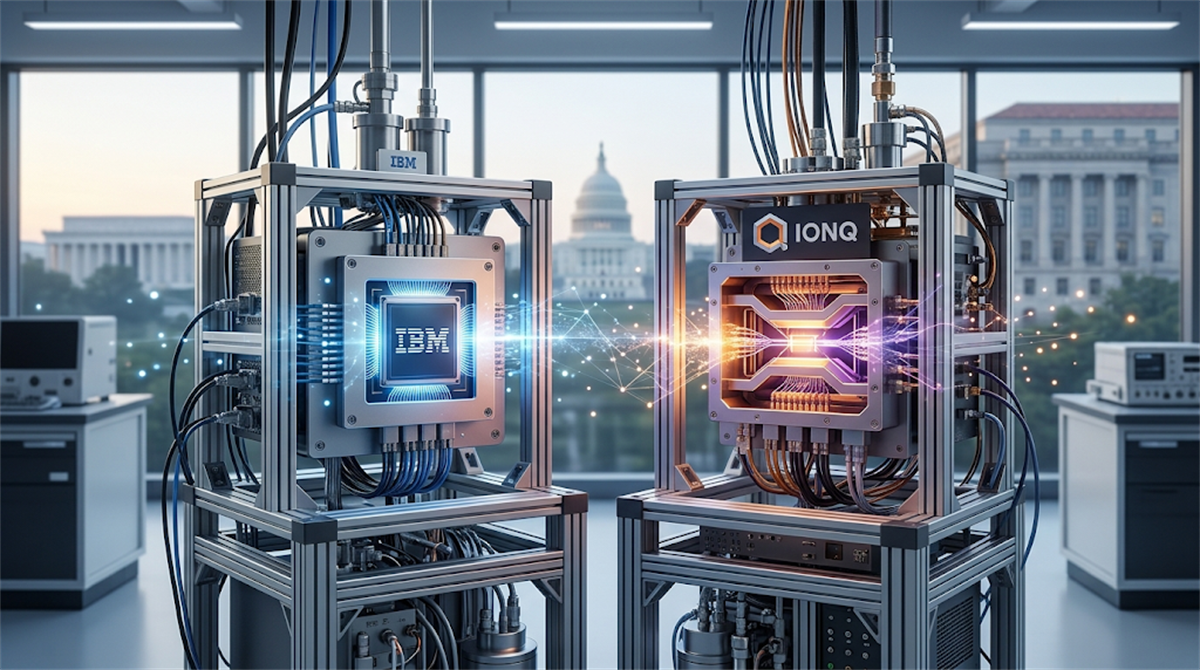
As an established institutional giant, International Business Machines (NYSE: IBM) is capturing the largest share of this sovereign deployment. On May 21, 2026, the company signed a Letter of Intent to establish Anderon, a standalone independent subsidiary operating as America's first 300mm quantum wafer foundry in Albany, New York.
Backed by a $1 billion Department of Commerce CHIPS Act award and a matching $1 billion cash and intellectual property commitment from IBM, Anderon will supply superconducting silicon quantum wafers to outside hardware developers. This picks-and-shovels model positions the enterprise as the primary tollbooth of the domestic quantum economy.
Anderon anchors a broader $10 billion, five-year quantum spending plan targeting the development of its fault-tolerant hardware roadmap. This roadmap focuses on delivering the Quantum Starling system by 2029 and the Quantum Blue Jay system by 2033.
Robust operations support this roadmap, as Q1 2026 earnings highlighted $15.92 billion in revenue under generally accepted accounting principles (GAAP), representing 9.5% year-over-year (YOY) growth. Non-GAAP gross margins expanded by 110 basis points (BPS), driven by high-margin software integrations.
On June 22, 2026, the corporate giant joined OpenAI's Daybreak Cyber Partner Program, backed by a $5 billion investment in Project Lightwell alongside Red Hat to secure enterprise applications. To support these capital-intensive initiatives, the firm secured its cash position by extending its separate $10 billion syndicated credit lines the same day.
Following these catalysts, shares of IBM rebounded 4.93% on June 23, 2026, to close at $264.66. Analysts remain bullish, as JPMorgan upgraded the stock to Overweight with a $291 target, while the consensus target has risen to $306.94.
IonQ Claims Its Own Crown With Trapped-Ion Modality
In contrast to a heavy silicon foundry model, IonQ (NYSE: IONQ) represents a high-velocity, pure-play alternative. IonQ bypasses cleanroom fabs by utilizing an optics-intensive, trapped-ion hardware architecture. Because trapped-ion systems manipulate individual atoms in a vacuum using lasers, the company is less reliant on traditional semiconductor manufacturing supply chains.
This technological distinction explains why IonQ was omitted from the Department of Commerce's primary silicon-focused CHIPS Act awards. This independent status has allowed IonQ to focus entirely on commercial and defense integration. In January 2026, IonQ announced a $1.8 billion acquisition of SkyWater Technology, immediately expanding its advanced engineering footprint with aerospace and military clients.
This defense-first alignment is already translating to exceptional growth. On May 6, 2026, IonQ announced its Q1 2026 earnings, posting $64.7 million in revenue, a 754.7% increase YOY, beating consensus estimates by 30%. A backlog of $470 million prompted management to raise full-year 2026 revenue guidance to a range of $260 million to $270 million. Recently trading in the $57-$58 range, IonQ has gained 28.2% year to date (YTD). Wall Street analysts maintain a Moderate Buy consensus on the stock, with Rosenblatt holding a high price target of $100 and Northland Securities recently raising its target to $70.
Evaluating the Divergence for Your Tech Portfolio
The rapid expansion of the domestic quantum sector presents two distinct investment profiles. For conservative, yield-focused portfolios, IBM offers a stable 2.59% dividend yield, paid quarterly at $1.69 per share. Its sovereign partnerships, diversified hybrid-cloud revenue, and $10 billion credit backstop insulate it from near-term downside. Investors should remain mindful of broader enterprise software consulting friction, as evidenced by peer Accenture's (NYSE: ACN) recent guidance tightening, which could cap short-term margin expansion.
For aggressive portfolios seeking asymmetric upside, IonQ is a high-beta pure play with strong top-line momentum. The main concern for IonQ is its lack of near-term GAAP profitability, as its trailing 12-month earnings per share (EPS) are a 28-cent loss. Trading at over 64x forward sales, the stock remains highly sensitive to macroeconomic interest rate shifts and broad-market capital rotations.
Seizing Your Seat on the Quantum Throne
The structural convergence of national security defense mandates and direct government equity funding has permanently reduced downside risk for domestic quantum computing stocks. By establishing concrete federal deployment deadlines for 2028, 2030, and 2031, Washington has guaranteed a multi-year capital runway that is immune to consumer spending fluctuations.
Cautious investors may prefer to establish a core position in IBM to capture the stable, dividend-supported infrastructure play, while those with a higher risk tolerance might add IonQ to their watchlist as commercial adoption of its cryptography solutions accelerates.
Read More
- Domino's Stock Slides to 52-Week Low as Investors Digest CEO Change
- Your name isn't on our protected list yet (From American Alternative)
- Microsoft Solves AI’s Biggest Bottleneck With Chevron Deal
- Print this and keep it by your screen (From Profits Run)
- Getty Images’ OpenAI Deal Gives the Stock a New AI Licensing Story
- Cerebras Systems, Inc: The Next Rags-to-Riches AI Story?
- Micron’s HBM Surge Could Redefine the AI Growth Story
Stay Ahead of the Market
The best investment opportunities don't wait. Get our research and stock ideas delivered straight to your smartphone—so you never miss a market-moving opportunity. Our text alerts ensure you see timely stock ideas and professional research reports instantly, whether you're in a meeting, commuting, or away from your desk.
