
In partnership with

AI Won’t Replace Ranchers. But It Will Change Who Wins.

AI can analyse data.
AI can generate recommendations.
But someone still has to make things happen in the real world.
DIT AgTech combines hardware, AI, nutrition automation and real-time data to turn intelligence into action across livestock operations.
It gives ranchers technology that works alongside them, automating supplementation and helping them produce more with less.
That's Physical AI.
And it's already operating in the real world, across 500+ deployed units and 370,000 head of livestock on the platform.
As AI moves from screens into the physical economy, DIT AgTech is building the infrastructure for it in livestock production.
And the market is massive.
Livestock is still one of the world's least automated major industries. The race to bring Physical AI to it has barely begun.
Be one of the first to see where this is going.
𝘐𝘯 𝘮𝘢𝘬𝘪𝘯𝘨 𝘢𝘯 𝘪𝘯𝘷𝘦𝘴𝘵𝘮𝘦𝘯𝘵 𝘥𝘦𝘤𝘪𝘴𝘪𝘰𝘯, 𝘪𝘯𝘷𝘦𝘴𝘵𝘰𝘳𝘴 𝘮𝘶𝘴𝘵 𝘳𝘦𝘭𝘺 𝘰𝘯 𝘵𝘩𝘦𝘪𝘳 𝘰𝘸𝘯 𝘦𝘹𝘢𝘮𝘪𝘯𝘢𝘵𝘪𝘰𝘯 𝘰𝘧 𝘵𝘩𝘦 𝘪𝘴𝘴𝘶𝘦𝘳 𝘢𝘯𝘥 𝘵𝘩𝘦 𝘵𝘦𝘳𝘮𝘴 𝘰𝘧 𝘵𝘩𝘦 𝘰𝘧𝘧𝘦𝘳𝘪𝘯𝘨, 𝘪𝘯𝘤𝘭𝘶𝘥𝘪𝘯𝘨 𝘵𝘩𝘦 𝘮𝘦𝘳𝘪𝘵𝘴 𝘢𝘯𝘥 𝘳𝘪𝘴𝘬𝘴 𝘪𝘯𝘷𝘰𝘭𝘷𝘦𝘥. 𝘋𝘐𝘛 𝘈𝘨𝘛𝘦𝘤𝘩 𝘩𝘢𝘴 𝘧𝘪𝘭𝘦𝘥 𝘢 𝘍𝘰𝘳𝘮 𝘊 𝘸𝘪𝘵𝘩 𝘵𝘩𝘦 𝘚𝘦𝘤𝘶𝘳𝘪𝘵𝘪𝘦𝘴 𝘢𝘯𝘥 𝘌𝘹𝘤𝘩𝘢𝘯𝘨𝘦 𝘊𝘰𝘮𝘮𝘪𝘴𝘴𝘪𝘰𝘯 𝘪𝘯 𝘤𝘰𝘯𝘯𝘦𝘤𝘵𝘪𝘰𝘯 𝘸𝘪𝘵𝘩 𝘪𝘵𝘴 𝘰𝘧𝘧𝘦𝘳𝘪𝘯𝘨, 𝘢 𝘤𝘰𝘱𝘺 𝘰𝘧 𝘸𝘩𝘪𝘤𝘩 𝘮𝘢𝘺 𝘣𝘦 𝘰𝘣𝘵𝘢𝘪𝘯𝘦𝘥 𝘩𝘦𝘳𝘦: https://bit.ly/4bzuWCi
I'm handing you this one free (From Behind the Markets)

Key Points
- SoundHound's Q3 revenue rose more than 48% to $62.4 million, but compressed margins and strategic shedding of legacy contracts widened losses.
- Management guided for $255 million in 2026 revenue and forecasts reaching positive EBITDA in the second half of next year.
- Heavy short interest and mixed analyst sentiment could keep SoundHound shares volatile despite the company's long-term growth potential.
- Special Report: This tech will replace data centers (From Chaikin Analytics)
The ugly truth behind SoundHound’s (NASDAQ: SOUN) Q3 results is that costs are rising, compressing gross margins and widening adjusted losses. However, it's wrong to view these statistics as signs of impending doom, because the pain is self-inflicted, part of the company’s strategy, and has it at an important inflection point. That is, from cash burn to positive adjusted EBITDA, which management forecasts for the back half of next year, only three to four quarters away. This transition could provide a powerful catalyst for a market long plagued by doubts.
SoundHound’s strategy is to build an AI-powered voice platform for enterprise automation. It includes numerous acquisitions, such as LivePerson, which expanded the addressable market, product portfolio, cost savings, and cross-selling opportunities. Within this, the company is shedding excess baggage, including lower-margin, dilutive legacy contracts, which execs are allowing to lapse. Today, the impact is weaker growth and wider losses than would otherwise be reported, alongside a rapidly shifting operational environment supporting the long-anticipated profit transition.
A free stock pick, from me to you (Ad)
Elon's paid this chip supplier since 2012. When NVIDIA tried to buy the company, he fought the deal.
Without its chip, his AI satellites don't fly. Now he wants 1,000,000 of them in orbit, 100 times what's up there today, and every one pays this company a royalty.
Dylan believes shares could react by December 8th.
Claim this free stock pick before the December 8 deadline today
SoundHound Guides for Strength in Q4 and 2027
SoundHound posted a solid quarter despite wider losses. The company brought in $62.4 million, up more than 48% and outpacing MarketBeat’s consensus. Growth came from strength across verticals, including new enterprise wins, upsells, and renewals. More importantly, the company received positive feedback from LivePerson’s largest clients, representing approximately $100 million in annual recurring revenue. Execs reported encouraging feedback about continued business and interest in enterprise-level agentic voice services.
Margin is the sore spot, with non-GAAP gross margin falling nine percentage points year over year to 50.3%, while adjusted losses widened. Despite the top-line strength and an earnings-per-share beat, widening adjusted losses and margin pressure remain concerns. Guidance is the offset: management forecasts $255 million in 2026 revenue at the midpoint, better than expected, and sustained, nearly 50% growth in 2027, with the longer-term forecast likely to be cautious.
Factors that could support growth in Q4 and 2027 include cross-selling to LivePerson’s clients, new enterprise wins, the transition to a software-as-a-service (SaaS) model, and scaling operations. LivePerson is an opportunity not to be underestimated, as its clients include 25 of the Fortune 100, a high double-digit number of Fortune 500 companies, and 35% of Forbes’ Most Valuable Brands.
The operational shift includes shedding legacy business in favor of new, hosted services built on the OASYS platform, effectively transitioning SoundHound to a higher-margin SaaS business. Scale is seen in recent deals such as the one to bring SoundHound-powered commerce to LG Smart TVs, potentially opening a new revenue stream.
Analysts' Mixed Responses Highlight SoundHound’s Long-Term Opportunity
The few analysts’ responses emerging immediately after SoundHound's report are mixed. Analysts are highlighting both the near-term margin headwinds and the long-term opportunity, cutting price targets but reaffirming their ratings. The consensus rating in early November is Hold, although analyst sentiment leans positive. Institutional activity has been modest, with slightly more buying than selling. Price targets are favorable, suggesting a market disconnect, with SOUN stock trading well below the consensus target and analysts forecasting more than 100% upside.
Short selling is among the biggest risks for investors. SoundHound’s cash-burning status and uncertainty attracted flocks of short-sellers, driving short interest to over 40%, where it has hovered for months. With this in play, SOUN shares could struggle to advance without a strong catalyst and may face hurdles even if one emerges. Short-covering triggers center on the LivePerson acquisition, enterprise wins, and the transition to profitability, which are unlikely to emerge before the Q4 earnings report. The silver lining is that, with days-to-cover above 10 and short interest so high, the upside potential for a short squeeze is massive.
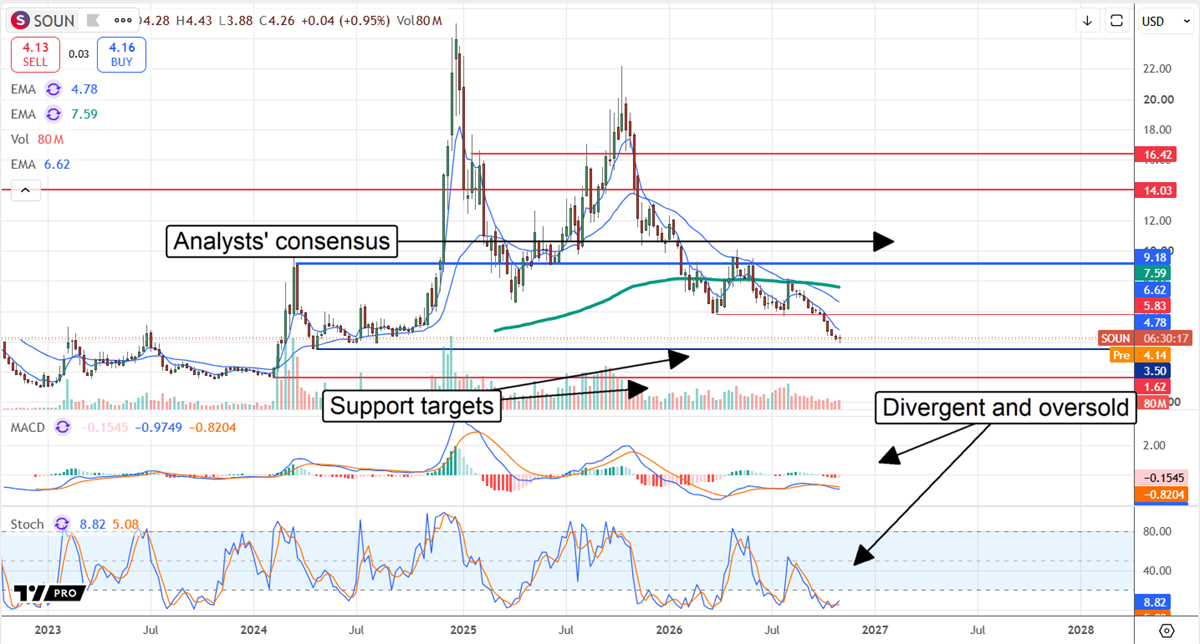
There’s no way to know for sure where SoundHound’s stock price bottom is, when it will be set, or how high it will get on the rebound, but investors can watch signals to help gauge direction and timing. Among them are the stochastic and MACD oscillators, which help measure momentum, market strength, and direction.
Price action is trending lower in Q4, with stochastic and MACD reflecting divergence and an increasingly weak bearish force. The setup suggests an imminent rebound, needing only a catalyst to trigger it, potentially delivered in early 2027 with the Q4 release and 2027 guidance update. Until then, support is possible but not guaranteed near the April 2024 lows and the February 2024 lows if the first target is broken. SoundHound's risks include competition, but it has a moat with its differentiated approach to voice, which enables higher-quality responses and interactions.
Recommended Stories
- Lemonade's Revenue Soars 73%—So Why Did Its Stock Turn Sour After Earnings?
- Don't lose access to this (From TradeWins)
- Anthropic's S-1 Strengthens the Case for Broadcom's AI Growth
- Why retirees are watching Trump's 1929 comment closely (From USA Capital Gold)
- After the Midterms, Which of These 3 Defense ETFs Looks Strongest?
- Dutch Bros Gave Wall Street What It Wanted, So Why Did the Stock Crater?
- Astera Labs Just Crushed Earnings—So Why Are Analysts Cutting Price Targets?

Stay Ahead of the Market
The best investment opportunities don't wait. Get our research and stock ideas delivered straight to your smartphone—so you never miss a market-moving opportunity. Our text alerts ensure you see timely stock ideas and professional research reports instantly, whether you're in a meeting, commuting, or away from your desk.
