
Your balance can grow while your buying power shrinks. (From Monetary Gold)
Key Points
- MGM Resorts shares have fallen sharply since Barry Diller's People Inc. withdrew its $48.30 per share takeover offer on Sept. 23.
- Reporting indicates Diller walked away due to deal financing and debt concerns, not problems with MGM's casino business or management.
- Tilman Fertitta's $31 per share buyout of Caesars Entertainment suggests private buyers still value Strip assets well above MGM's current stock price.
- Special Report: Record-High Copper Fuels This Below-$2 Discovery Stock (From Resource Stock Digest)
MGM Resorts International (NYSE: MGM) stock is down about 17% in 2026. Most of that damage has come since the beginning of June. That's a strange result for a company that just reported record second-quarter consolidated net revenues.
The explanation isn't in the company's Q2 2026 earnings report. It's in the noise surrounding a possible takeover deal. On June 1, Barry Diller's People Inc. (NASDAQ: PPLI) offered $48.30 per share for the MGM shares it didn't already own. Then on Sept. 23, Diller walked away.
That $48.30 share price was about a 10% premium to the MGM closing price on May 29. The stock has now round-tripped that entire takeover premium, and then some. Shares traded near $30.40 on Oct. 1. That's below anywhere the stock traded in the spring, before the bid sent it soaring.
Investors are treating Diller's exit as a verdict on MGM's business. The available evidence says it was a verdict on deal financing.
Those are very different things. For investors willing to separate that perception from the company's fundamentals, the MGM sell-off deserves a closer look.
The retirement stock I'd buy before Nvidia today (Ad)
In 2014, Marc Chaikin pointed readers toward Nvidia. Now the 60-year Wall Street veteran and creator of the Chaikin Money Flow indicator has a new top retirement pick.
The company holds three fast-growing businesses -- including an autonomous vehicle unit and a streaming service with 10x Netflix's reach -- any of which could be spun off in the next 12 to 24 months. It also pays a dividend, a rarity among high-growth AI names.
Chaikin lays out the full case in a new free presentation, no email or credit card required.
Get Marc Chaikin's free presentation on this overlooked AI stock now
The Diller Bid Was a Premium, Not a Promise
Diller's offer came in at a 10.6% premium to its May 29 close. It was also a 30% premium to the stock's 90-day volume-weighted average price. MGM jumped about 14% on the news, briefly trading above $50.
That means investors weren't just pricing in the deal. They were pricing in a higher one. Several analysts argued $48.30 undervalued the company.
But People already owned roughly 27% of MGM, and Diller sits on its board. That made a rival bidder unlikely. The market was effectively expecting Diller to bid against himself.
Through the summer, each week without a higher bid eroded the premium. By mid-September, MGM was trading below $38. When the withdrawal hit, the stock fell nearly 11% in a single session to $33.69. It hasn't found a floor since.
Why Diller Walked Matters More Than the Fact That He Walked
Diller said the "mix" simply wasn't coming together. Reporting since then has filled in the gaps. Bloomberg reported that outside investors were reluctant to fund a complex deal built around a minority stake. CNBC's David Faber reported that the debt load the deal would have placed on People helped cool Diller's interest.
However, what's missing from that list is any inference that Diller found something wrong with the casinos. In fact, People still holds 66.8 million MGM shares. Diller said the company remains confident in MGM's management and remains open to a strategic transaction.
This may be a common behavior trap. When an insider exits a deal, investors assume the insider knows something. Here, the insider's stated reasons point to issues with the capital structure, not the business quality.
Nvidia pours 7 billion into a light speed AI breakthrough (Ad)
Nvidia has invested more than 7 billion dollars into a light speed device that could reshape how AI systems operate.
Bill Gates put in over 200 million of his own money, while BlackRock, Vanguard, Morgan Stanley and Norway's sovereign wealth fund are positioning around it. Related stocks have already climbed 133 percent, 217 percent and 320 percent.
Wall Street analyst Jason Bodner, who called Nvidia at 4.50, is sharing his top pick tied to this trend at no cost.
Click here to see Jason Bodner's free AI stock pick
The Fundamentals Aren't Broken, But They Aren't Clean
To be fair to the bears, MGM's numbers aren't spotless. Second-quarter revenue rose 1% to $4.5 billion. Las Vegas Strip revenue and adjusted EBITDAR both grew 3%, driven by luxury demand. Regional operations posted their best-ever same-store quarter.
But consolidated adjusted EBITDA slipped to $610 million from $648 million a year earlier. MGM China's EBITDAR fell 15%. At BetMGM, sports betting revenue was flat, and adjusted EBITDA dropped 15%.
The Las Vegas backdrop isn't helping. Visitor volume fell 4.3% in August, and Strip hotel occupancy dropped to 74.1%. MGM is winning with high-end guests while the middle-income traveler stays home. That's a K-shaped consumer story, and it carries real risk if the luxury customer pulls back.
The Caesars Comp Is the Actionable Number
While the MGM deal is getting all the attention, there's another deal that may make a more compelling case for MGM. Tilman Fertitta is paying $31 per share for Caesars Entertainment (NASDAQ: CZR), a deal valued at $17.6 billion including about $11.9 billion of debt.
That's a 49% premium to Caesars' unaffected share price. Estimates put the price at roughly 9x EBITDA. Caesars shareholders approved it the same week Diller walked away from MGM.
Caesars faces the same Vegas headwinds as MGM. It carries more debt and has a weaker digital business. A private buyer paid up anyway.
That makes the case that the private-market value of Strip assets hasn't collapsed. The public market is pricing MGM as though no buyer exists. And Diller's own $48.30 offer shows what an informed insider was willing to pay just four months ago.
One caution: MGM leases most of its real estate, so multiple comparisons should be lease-adjusted. But directionally, the gap between private and public valuations is hard to miss.
Goldman Was Right on Direction—Look Where the Stock Is Now
In mid-July, Goldman Sachs gave MGM a Sell rating with a $43 price target. At the time, that looked like a bet the deal premium wouldn't hold. Goldman was right.
But MGM now trades roughly 29% below Goldman's bearish target. Bank of America, which reinstated coverage at Neutral after the withdrawal, set a $40 target. Even the cautious calls on the Street sit well above today's price. When a stock blows through the bear case that quickly, it means that perception has gotten ahead of the company's fundamentals.
The Chart Is Screaming Oversold, But Listen Carefully
MGM's 14-day relative strength index (RSI) recently sat near 11. Any reading below 30 is considered oversold. RSI readings this low are rare for a large-cap stock.
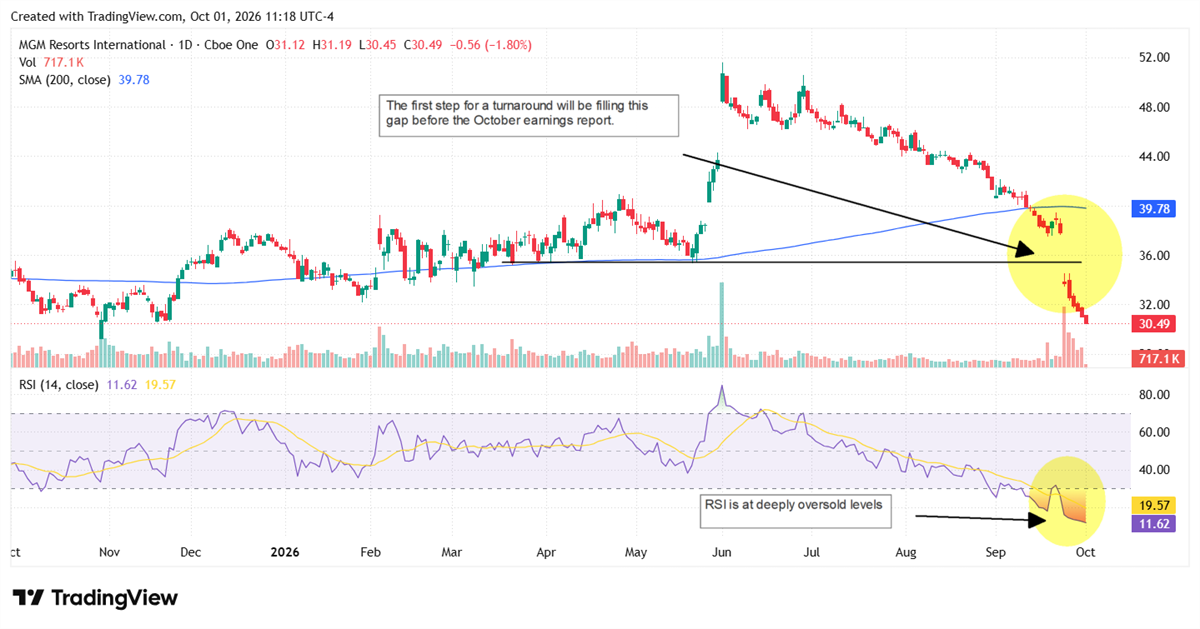
The stock is also well below its 200-day simple moving average near $39.80. That average has started to roll over, which is a bearish sign for the longer-term trend. The Sept. 24 sell-off left an unfilled gap between roughly $34.50 and $37.50.
MGM is now testing its November 2025 lows near $30.50. Its 52-week low sits just above $29.
Here's the nuance. Oversold is a condition, not a signal. It confirms that selling has been extreme. It doesn't confirm that selling is over. Volume spiked on the withdrawal, then faded as the stock drifted lower. That can point to exhaustion, but the chart hasn't confirmed a reversal yet.
Further Reading
- Could Nike’s Brutal Sell-Off Finally Be Running Out of Steam?
- The $15 Gold Fund That Pays Up to $1,152/Month (From Investors Alley)
- The AI Buildout Needs Power It Cannot Get: 4 Energy Stocks Already Have It
- Bezos… DOOMED? (From Paradigm Press)
- McDonald's Is Undergoing a Massive New Growth Strategy. Can It Win Back Consumers?
- Liberty Energy’s AI Power Push Has Wall Street Divided
- Why Valley National Is Buying Growth Instead of Building It

Stay Ahead of the Market
The best investment opportunities don't wait. Get our research and stock ideas delivered straight to your smartphone—so you never miss a market-moving opportunity. Our text alerts ensure you see timely stock ideas and professional research reports instantly, whether you're in a meeting, commuting, or away from your desk.
